
B-ENGINEERING provides smoke control design, installation, testing, and commissioning in Lebanon, Ivory Coast, and Cameroon, including smoke extraction, pressurization, jet fans, and fire alarm integration.
Why Smoke Control Requires Integrated Engineering
Smoke control is a critical part of building safety, especially in complex environments where smoke can move quickly through basements, shafts, staircases, atriums, corridors, and large open spaces. During a fire, smoke can reduce visibility, obstruct evacuation routes, and create dangerous conditions for occupants and emergency responders. A well-designed smoke management system helps control this risk.
Complex buildings require more than simple exhaust fans. They need an integrated smoke control strategy that considers airflow, building geometry, fire zones, escape routes, control logic, and coordination with the fire alarm system. Smoke extraction, pressurization, dampers, jet fans, and electrical controls must work together as one life-safety system.
B-ENGINEERING supports construction projects with smoke control solutions that combine mechanical installation expertise, electrical coordination, and practical site execution. The company approaches smoke management as a safety-focused building service that must be reliable during emergency conditions.
Smoke Extraction, Pressurization, and Jet Fan Systems
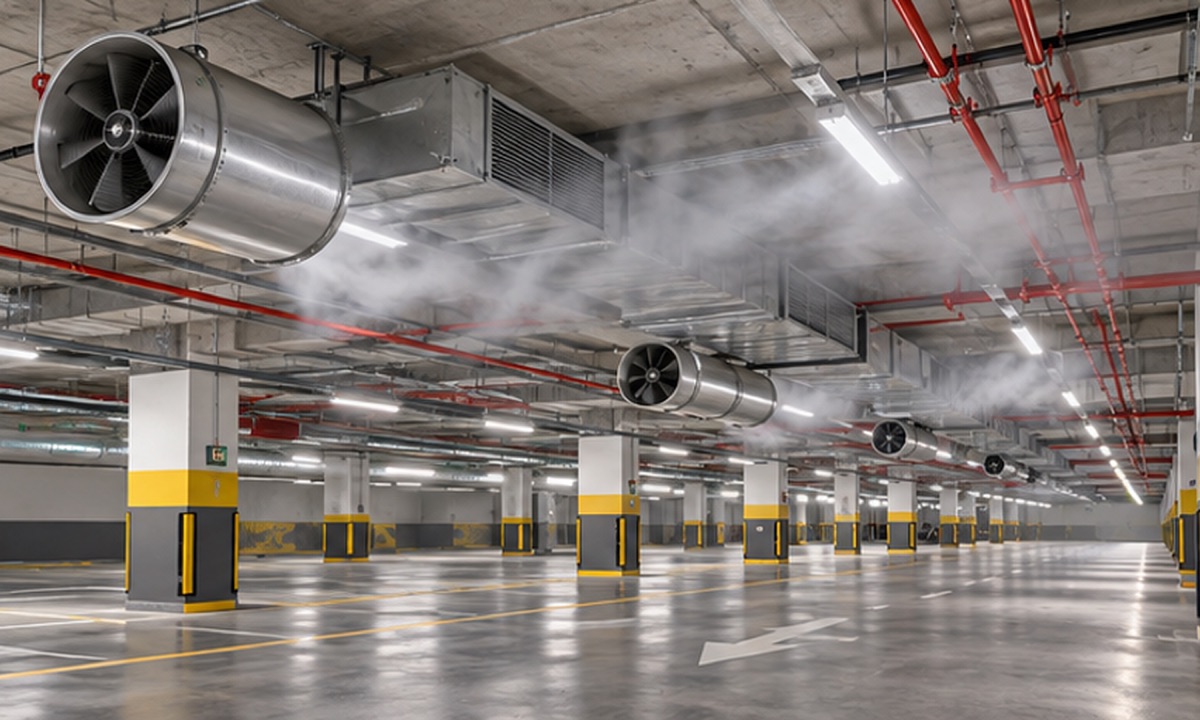
Different areas of a building may require different smoke control methods. In underground parking areas, jet fans and exhaust fans may be used to guide smoke toward extraction points and reduce smoke accumulation. In staircases and lift lobbies, pressurization systems help limit smoke entry and protect evacuation routes. In large atriums or commercial spaces, smoke extraction systems may be designed to control smoke movement near high ceilings and open volumes.
A complete smoke management system may include smoke extraction fans, pressurization fans, jet fans, motorized dampers, smoke dampers, ductwork, shafts, electrical panels, sensors, and fire alarm interfaces. Each component must be properly selected, installed, and coordinated with the project’s fire safety strategy.
B-ENGINEERING focuses on delivering smoke management systems that are practical for construction and dependable in operation. This means considering fan locations, duct routes, damper access, cable routes, maintenance clearances, and testing requirements from the beginning.
Control Logic and Fire Alarm Integration
Smoke control systems depend heavily on control logic. During an emergency, the system must respond correctly to signals from the fire alarm system. Fans may start, dampers may open or close, pressurization units may activate, and smoke zones may operate according to a defined sequence.
This makes coordination between mechanical installations and electrical installations essential. Control panels, power supplies, fire alarm interfaces, sensors, dampers, and fans must all be connected and tested as a complete system. If one part of the sequence fails, the performance of the entire smoke management strategy may be affected.
As an MEP contractor, B-ENGINEERING understands the importance of integrating smoke control with the full building infrastructure. Mechanical equipment must be installed correctly, and electrical controls must be coordinated with the intended emergency operation.
Commissioning for Life-Safety Performance
Smoke management systems require thorough testing and commissioning. Fan operation, damper movement, pressure levels, control sequences, fire alarm interfaces, and system response must be verified before handover. This process helps confirm that the system behaves as intended under emergency scenarios.
Commissioning also helps identify adjustments that may be needed after installation. Airflow paths, leakage, pressure differences, damper response, and equipment performance can all affect final results. Careful testing gives project owners and consultants more confidence in the life-safety performance of the building.
Through engineered smoke control solutions, B-ENGINEERING helps projects improve evacuation safety, protect escape routes, and support better emergency preparedness. In complex buildings, a reliable smoke management system is not only a technical requirement. It is a key part of protecting people and preserving building safety.
Partner with B-ENGINEERING to design and execute smoke control systems that support safer evacuation and stronger emergency preparedness.